

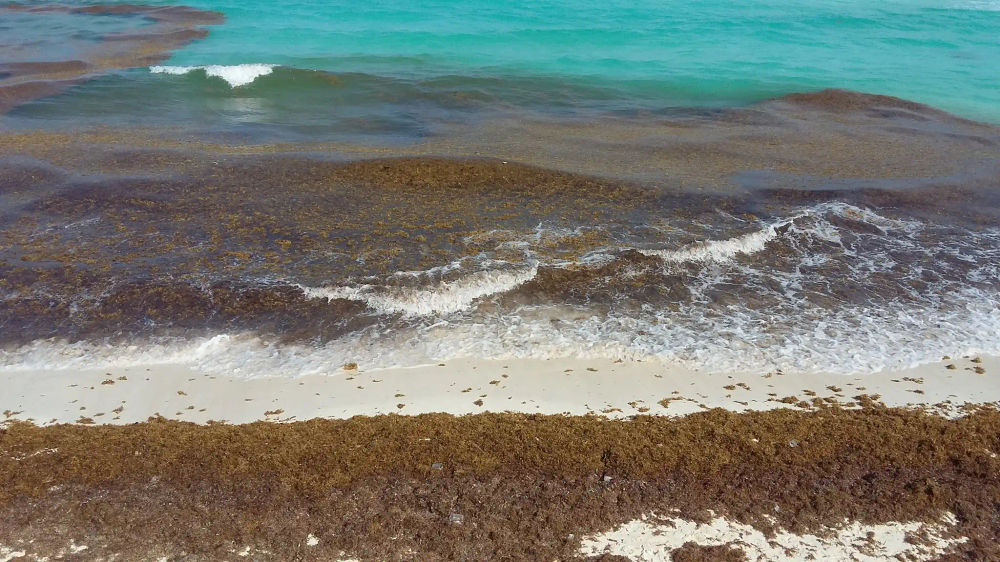
A massive bloom of sargassum seaweed, visible from space, is drifting steadily across the Atlantic, threatening to blanket the beaches of the Mexican Caribbean with more algae than seen in any previous year, including the record-setting 2018 season. With satellite data indicating over 37.5 million metric tons of sargassum currently afloat, scientists warn that 2025 may mark a turning point in the region’s ongoing battle with this recurring ecological crisis.
The vast “Great Atlantic Sargassum Belt,” as researchers have dubbed it, stretches for hundreds, perhaps thousands, of kilometers. Originating in the waters between Brazil and West Africa, the belt has been steadily migrating northwest, threading through the Caribbean Sea en route to the southern United States. “It’s bigger than any single country,” noted Briggita Ine Von, a marine botanist and founder of the Seagrass Laboratory at UNAM’s Institute of Marine Sciences and Limnology.
According to Von, atmospheric and oceanic conditions this year mirror those of 2018, with no significant influence from El Niño or La Niña, and similar wind and current patterns. Yet, the sheer scale of the bloom this season far surpasses what the region has experienced before. “In May alone, we recorded nearly double the biomass seen in July 2018,” she stated, referencing ongoing monitoring efforts by the University of South Florida.
A Recurring Challenge with Long-Term Impacts
While sargassum is a natural phenomenon, vital in small quantities to marine ecosystems, its overwhelming accumulation near shorelines poses significant environmental and economic threats, Dr. Lorenzo Álvarez, a reef systems researcher at UNAM, emphasized that although local, state, and federal governments have taken action, a lack of consistent follow-through continues to undermine efforts.
“The issue isn’t just cleaning the beaches,” Álvarez said. “It’s about managing what comes next, where to confine the recovered biomass, how to prevent it from leaking nutrients into the aquifer, and how to avoid further damage to lagoon ecosystems.”
Indeed, the absence of proper storage or processing facilities means much of the collected sargassum ends up contributing to the very problems efforts aim to resolve. Runoff from decomposing seaweed leaches into the ground and disrupts delicate freshwater systems, introducing excess nutrients that fuel algal blooms and further destabilize coastal environments.

Local Responses, Mixed Realities
On the ground, the picture is uneven. In Mahahual, a coastal town in the municipality of Othón P. Blanco, hoteliers report relatively mild sargassum levels so far this year. Yet just offshore, fishers have been forced to suspend operations, their nets tangled and yields devastated. A particularly disheartening sight greeted them one recent morning, sardines washed up dead along the beach, apparently suffocated by the algae’s rapid spread.
In Playa del Carmen, however, the situation is deteriorating more rapidly. Local environmental authorities confirmed that weather conditions have intensified sargassum accumulation, particularly in the popular areas of El Recodo and Punta Esmeralda. “We are seeing considerable impact to our coastlines,” said Samantha Álvarez, the region’s Secretary of the Environment. She noted that emergency response teams are already mobilized, though the scale of the task grows daily.
A Battle Measured in Years, Not Seasons
What makes sargassum particularly insidious is its long-term ecological toll. Von explained that even immediate action cannot restore affected ecosystems to their pre-2014 state, the year the first major sargassum arrival stunned the region. “We’re talking decades,” she said plainly, underscoring the depth of transformation in coastal habitats.
Still, there are glimmers of progress. Barrier systems designed to deflect the floating mats have shown promise in some areas. Yet without consistent investment and a coordinated strategy that spans municipal borders and national priorities, such measures remain piecemeal.
The truth is, this isn’t a problem that can be solved by shovels and boats alone. It demands imagination, investment, and resilience, from governments, from local industries, and from the communities that call this coastline home.
As Tulum and its neighboring towns brace for what could be the heaviest influx of sargassum in recorded history, the need for durable solutions grows ever more urgent. The question is no longer if the seaweed will arrive, it’s how we will respond once it does.
Join the conversation on our social media platforms and share your thoughts on how the region should address the rising tide of sargazo en el Caribe mexicano.