
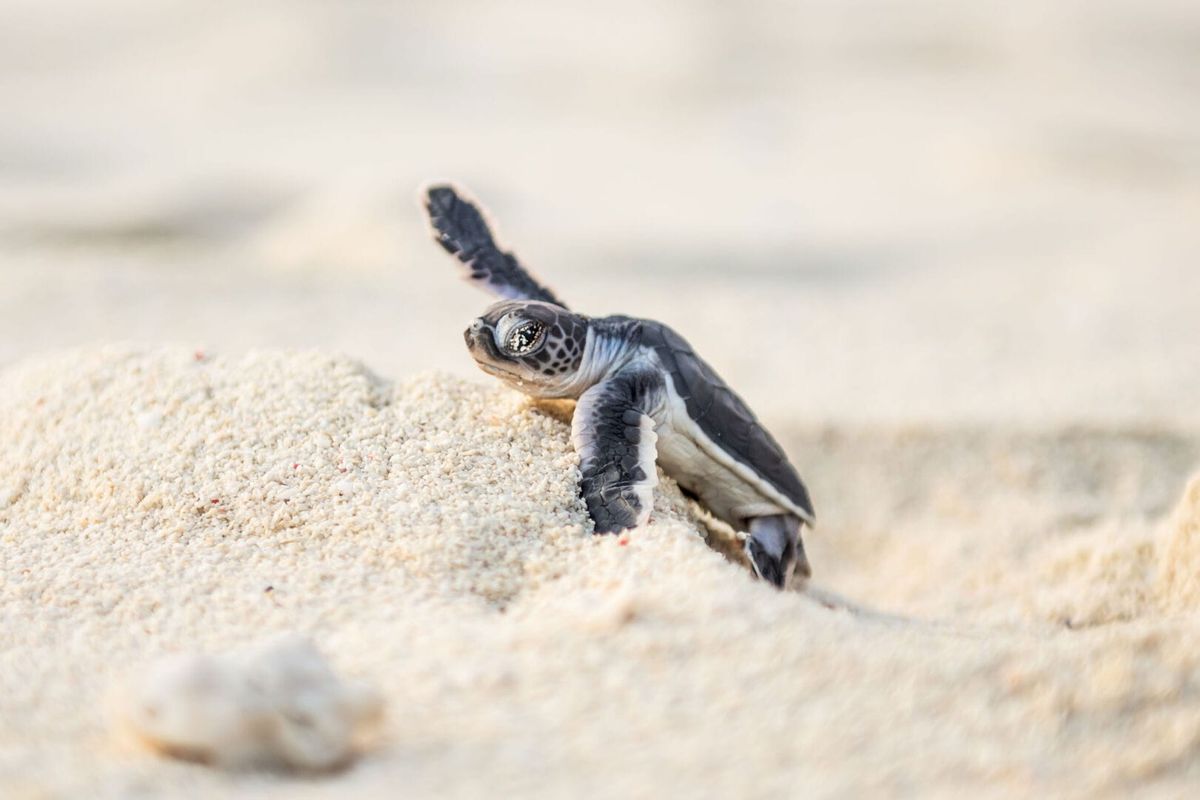
Some stories begin with thunder, others with silence. This one starts with a trail no wider than a thumb, carved across the moonlit sands of Playa 72 in Playa del Carmen. A dozen baby sea turtles, no larger than bottle caps, wobbling their way toward the Caribbean surf. No fanfare, no audience, just instinct, stars, and the rhythm of the waves calling them home.
Locals spotted the emergence just after dawn, a lucky break for early beachgoers. The hatchlings had exploded, the term conservationists use for the sudden burst of movement when baby turtles emerge from the sand, and made their treacherous dash to the sea. It’s a seasonal miracle in the Riviera Maya, and a powerful reminder of nature’s fragile clockwork.
But what should you do if you stumble upon this ancient ritual?
Let’s talk about it.
The Quiet Urgency of Sea Turtle Nesting Season in Riviera Maya
Each year, from May through October, the coasts of Quintana Roo transform into one of the most critical nesting zones for sea turtles in the Western Hemisphere. Four of the world’s seven sea turtle species lay their eggs along the beaches of Tulum, Playa del Carmen, Akumal, and beyond. These include the Loggerhead, Green Turtle, Hawksbill, and occasionally the Leatherback.
The process begins at night. Female turtles, some more than 30 years old, return to the very beaches where they hatched, guided by Earth’s magnetic field. Under the cover of darkness, they dig nests, lay between 80 and 120 eggs, cover them carefully, and disappear into the sea.
Roughly 45 to 60 days later, the hatchlings erupt from the sand, usually at night, and instinctively head for the brightest horizon, which should be the ocean. But increasingly, it’s the glow of beachfront hotels or headlights.
And that’s when things get complicated.

What To Do (and Not Do) If You Encounter Hatchlings on the Beach
It’s one of the most delicate and high-stakes moments in the turtles’ life cycle, and your actions matter.
Here’s what you should do:
✔️ Turn off all lights nearby
Sea turtles hatch at night and use the natural glow of the horizon to find the ocean. Artificial lights, including phone screens, flashlights, car headlights, or hotel lights, can disorient them, sending them in the wrong direction and dramatically lowering survival rates.
✔️ Keep your distance
It might be tempting to get close or even touch them, but resist. Stay behind the turtles. Never stand between them and the sea. Your presence alone can cause confusion or block their path.
✔️ Alert the local authorities or conservation groups
Each beach usually has an assigned protection brigade or a hotline. In Playa del Carmen, you can reach out to municipal environmental services or known conservation organizations like Flora, Fauna y Cultura de México or Grupo Tortuguero del Caribe. Save the number before you head to the beach, just in case.
✔️ Calmly inform others nearby
If you’re with other tourists or beachgoers, ask them to turn off lights, remain quiet, and avoid crowding the hatchlings. Most people don’t know the rules, they just need a gentle reminder.
✔️ Block or redirect potential danger
If you see beach vehicles (quad bikes, ATVs, utility trucks) heading toward the nest area, flag them down safely and point out the hatchlings. Likewise, if the beach has pets off-leash, notify the owner immediately.
✔️ Watch, don’t help
Unless you’re a trained conservationist, do not pick up hatchlings or try to “guide” them. Crawling over the sand is essential, it’s how they imprint the magnetic signature of the beach, which they’ll use decades later to return and lay their own eggs.
✔️ Keep flash photography off
Even a quick photo can startle or mislead the hatchlings. If you must take a picture, use night mode with the flash disabled, or better yet, just savor the moment and leave it undocumented.
✔️ Report nest locations if unmarked
If you see a fresh turtle nest that isn’t cordoned off or marked, notify beach authorities or local patrols. Early reporting helps protect the nest from accidental trampling or predators.
And here’s what you must avoid:
✖️ Don’t touch the turtles
Even if one looks stuck or struggling, do not intervene. Many hatchlings pause to rest or reorient, and what looks like distress might be part of their natural process.
✖️ Don’t shine lights, even to “help” them see
What seems helpful (like shining your phone toward the sea) can backfire badly. It disorients them and interferes with their navigation.
✖️ Don’t remove obstacles or “clear the way”
Sand ridges, driftwood, and even seaweed are part of the journey. The effort it takes to reach the ocean is part of their physical development.
✖️ Don’t dig into nests or move eggs
If you spot eggs or see a nest being exposed, do not touch it. The position and depth are critical, and mishandling could kill the entire clutch.
✖️ Don’t bring dogs or let them roam
Even the friendliest pet can accidentally step on a hatchling or dig into a nest. Beaches with turtle activity should be pet-free zones during nesting season.
✖️ Don’t post real-time locations publicly
Avoid broadcasting the exact beach and time where you saw hatchlings until the event is over. This prevents crowds or curious onlookers from overwhelming the area and causing harm.
A Micro-Story from Playa 72
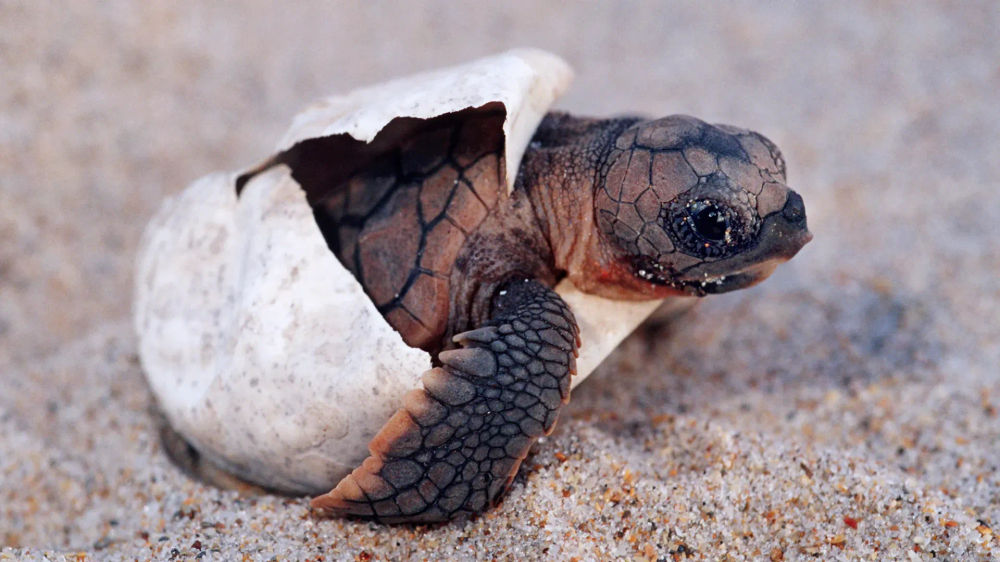
Last Sunday, local barista Laura Méndez was on her usual morning jog when she noticed strange movement near a clump of sargassum. “At first I thought it was ants or crabs,” she told The Tulum Times, “but then I saw the flippers, tiny, flailing, perfect.” She waited nearly an hour, guarding the area until a turtle patrol arrived.
A few tourists joined in, sitting silently in a semicircle as the hatchlings made their slow descent to the water. No selfies. No clapping. Just reverence.
Later that day, Laura posted a video on social media that went viral across Quintana Roo. It’s since become a reference for what to do, and what not to do, during turtle hatching season.

Conservation Under Pressure: Tulum vs. Playa del Carmen
While Playa 72 may still offer the kind of quiet protection hatchlings need, other parts of the Riviera Maya aren’t as lucky.
In Tulum, the booming tourism and unchecked beachfront development have led to increasing reports of nest disturbances. Beach clubs that ignore “dark beach” policies, illegal vehicle traffic, and unauthorized bonfires all interfere with turtle behavior.
By contrast, some Playa del Carmen hotels have worked closely with conservation programs to install red turtle-safe lighting, train their staff, and schedule nighttime beach patrols. But it’s far from perfect.
“It’s a constant race,” says one volunteer with Grupo Tortuguero Riviera Maya. “The turtles are adapting, but we need to move faster.”
The good news? People are starting to care. The viral visibility of these events has sparked a fresh wave of interest among both locals and tourists, and that’s crucial.

The Role of Local Organizations and What’s Next
Numerous groups in Quintana Roo monitor, protect, and document turtle nests. These include:
- Grupo Tortuguero del Caribe
- Flora, Fauna y Cultura de México
- Municipal brigades from Solidaridad and Tulum
Volunteers monitor the beaches at night, relocate vulnerable nests, and even conduct post-hatching data collection. Some programs allow tourists to participate, under strict supervision, helping spread awareness and support.
But experts warn that this isn’t just about turtles. “The state of the turtles is the state of our coast,” one biologist said. Their survival reflects our environmental health.
And yet, despite years of campaigns, illegal lighting, plastic waste, and shoreline erosion continue to threaten these species.

A Ritual Worth Protecting
Watching a sea turtle hatchling make its first journey to the sea is a kind of holy moment. It shrinks your worries, stretches your sense of time, and reminds you that the best things in nature are often the quietest.
Playa 72 gave us one of those moments. And in return, maybe we owe these ancient mariners a little protection.
Next time you see tiny flippers on the sand, pause. Protect the path. And let the sea do the rest.
Because what’s at stake isn’t just a turtle, it’s the memory of a coastline that still breathes.
“We’d love to hear your thoughts. Join the conversation on The Tulum Times’ social media.”
Have you ever witnessed a turtle hatch in the wild? What did you do, or wish you had done?