
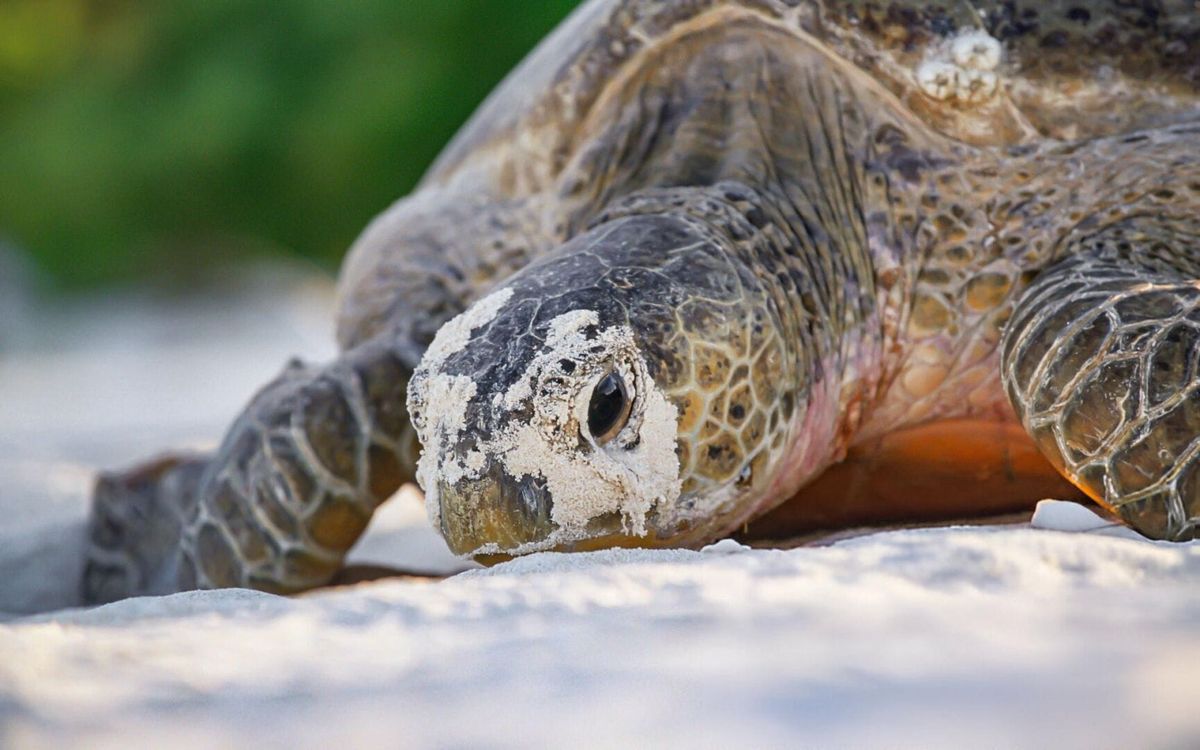
At night, on the dark shores of Xcacel-Xcacelito, you can still hear the soft, ancient rustling, flippers scraping against sand, centuries of instinct guiding a fragile shell toward survival. It’s easy to miss if you’re not looking. But they’re coming. Thousands of them.
Despite storms, looters, stray dogs, and the sprawling reach of human development, sea turtles are returning to the beaches of the Riviera Maya, close to 10,000 nests and counting this season alone.
Leonel Gómez Nieto, who heads the conservation program with the local nonprofit Flora, Fauna y Cultura de México, sounded both surprised and cautiously optimistic. “The season is active, very good for us, and we still have two to three more months to go,” he shared. Gómez oversees a protection network that spans 15 coastal points from Punta Venado to the edge of the Sian Ka’an Biosphere Reserve. Over 40 people, including staff and volunteers, work day and night to keep the sand safe.
But what does it take to protect 10,000 nests? And what do these numbers really mean in a region where hotel lights burn all night, construction trucks rumble by day, and unleashed dogs wander the coastline?

A Relentless Natural Ritual
The turtle species nesting in these areas, loggerhead (caguama), green turtle (blanca), and hawksbill (carey), have followed this migratory cycle for millions of years. One good year, one bad. That’s how it goes. And this year? It’s shaping up to be one of the good ones.
Yet, even the “good” years are laced with fragility.
“It’s not like the threats are new,” Gómez admits. “Every year, we deal with poaching.” The theft of eggs from nests, while not on an industrial scale, is a persistent menace. But the bigger problems today might not be the old ones.

New Threats, Old Beaches
There’s a growing problem with feral dogs and unregulated pets, many of them spilling out from nearby resorts and residential developments. These animals trample nests, dig up eggs, and carry bacteria in their feces that can endanger both volunteers and tourists.
“It’s not just about the turtles,” Gómez emphasizes. “We have to think about health, about people on the beach, about the long-term safety of these spaces.”
Efforts are now underway with local municipalities to implement better animal control and increase surveillance. But enforcement in these remote stretches of beach is always a game of cat and mouse, if the cats were bureaucrats and the mice laid eggs once a year under moonlight.

Tulum’s Paradox: Paradise and Pressure
Tulum has become shorthand for paradise, but paradise comes with pressure. As tourists flood in, drawn by shimmering cenotes and bohemian beach clubs, the ecological systems that define this place are being reshaped in subtle and not-so-subtle ways.
Compared to Cancún and Playa del Carmen, Tulum still retains stretches of beach that feel untouched. But appearances can be deceptive. The glow from hotel floodlights confuses adult turtles returning to nest. Restaurant furniture left out overnight blocks hatchlings from reaching the sea. Noise, light, and motion, what the human world considers convenience, can be deadly interruptions to a process older than civilization.
A Story Told in Sand
One volunteer recalled the moment a hatchling got caught in a plastic cup wedged between lounge chairs at a beachfront bar. “We found it the next morning, circling inside like it was in a glass maze. It died before we could get it to the water.”
Stories like these don’t make headlines. But they shape the quiet urgency behind the conservation work. Each lost turtle is a data point. Each rescued one is a tiny act of rebellion against the odds.
And still, they come.
Conservation With Teeth
To push back, the team works not only with volunteers but also with federal forces like the Navy and the National Guard, ensuring that key stretches of beach remain under a watchful eye during peak nesting season. It’s not martial law, it’s marine law, applied with the same mix of dedication and underfunding found in most ecological efforts across Mexico.
But true conservation can’t live on enforcement alone. Education remains central. Gómez and his team are ramping up efforts to inform tourists and locals alike about the nesting season, the rules of the beach, and how a single misstep can undo years of progress.
Hotels and restaurants are also being reminded, again, to install low-impact lighting and remove obstacles from the sand each night. These aren’t just guidelines. For the turtles, they’re lifelines.

What’s at Stake Isn’t Just Biodiversity
The story of the sea turtles isn’t just about animals. It’s about identity. It’s about whether places like Tulum can balance booming tourism with cultural and ecological integrity. The Riviera Maya is more than a vacation destination. It’s a living coastline. And the turtles? They’re a reminder of that heartbeat.
As Gómez puts it, “The turtles come back. That means something. That still means something.”
In a region where change is constant, new resorts breaking ground, roads being paved, populations rising, the ancient crawl of a sea turtle toward the ocean feels almost defiant.
And maybe that’s the point.