
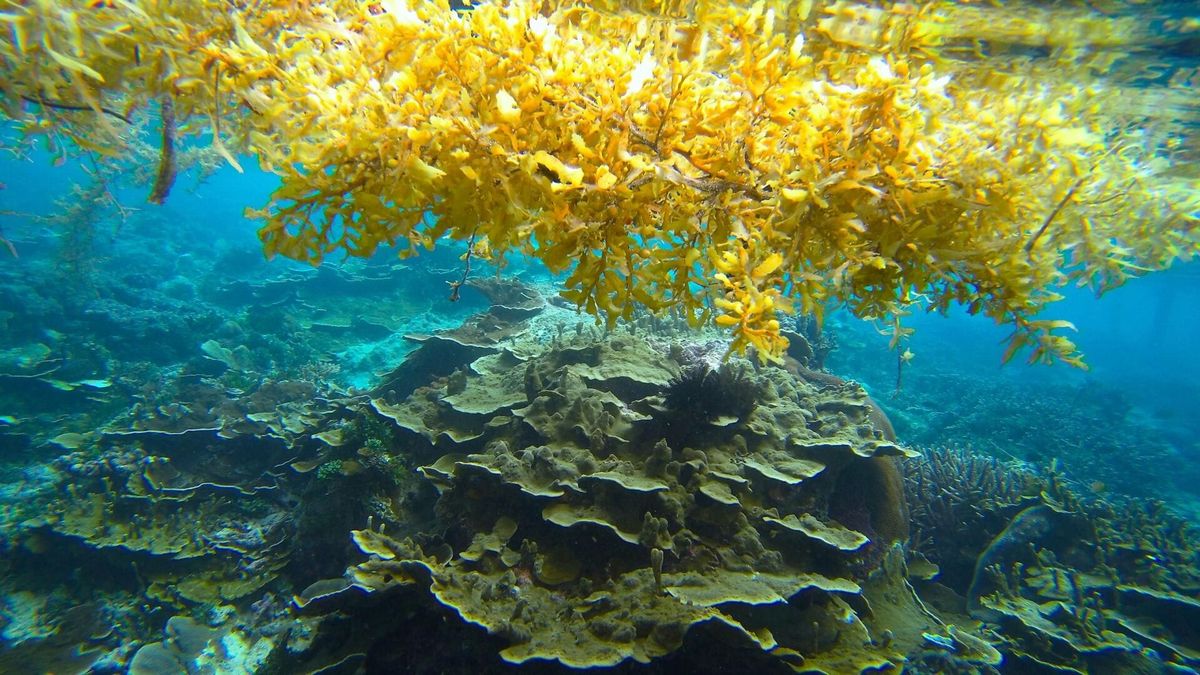
At sunrise in Tulum, the beach looks like a burnished battlefield. Waves of golden-brown seaweed carpet the once-white sand, piled in soggy drifts that steam under the climbing sun. A briny, sulfurous odor hangs in the air, part ocean, part rotten egg, strong enough to water the eyes of early beachcombers. Seagulls pick nervously at the pungent piles, and a few confused tourists snap photos with hands pressed over their noses. This is sargassum, and it has arrived yet again, uninvited, transforming Tulum’s pristine shore into a surreal tapestry of gold and brown. It’s a sight at once awe-inspiring and disheartening, nature’s grandeur gone slightly awry. And it begs the question: Where did all of this seaweed come from? To find the answer, we must journey far beyond the horizon, thousands of miles east, to the heart of the Atlantic Ocean.
Born in a Calm Blue Sea
The story of sargassum starts in the Sargasso Sea, a strange and legendary stretch of the North Atlantic named by 15th-century sailors who marveled (and cursed) at its floating masses of seaweed. Unlike most seas, the Sargasso has no land borders; it’s defined by swirling currents that corral the water into a vast, gently spinning eddy. For centuries, this was sargassum’s primary domain. In these calm blue waters northeast of the Caribbean, rafts of Sargassum algae bobbed peacefully, free-floating under the sun. The seaweed here lives its entire life adrift, never attaching to any seafloor, buoyed instead by little berry-like air bladders that keep it afloat. Generation after generation of sargassum clones itself in this way, breaking apart and multiplying on the open ocean. Golden mats sometimes miles wide would lazily circle the Sargasso Sea, serving as a floating oasis for marine life. Tiny fish and crabs shelter in its tangle; baby sea turtles ride in its midst, nibbling on the buffet of critters it attracts. Out at sea, in balanced amounts, sargassum was not a villain at all, it was a cradle of life, a drifting sanctuary in an otherwise sparse ocean desert.

For ages, those golden mats largely stayed put, or at most, only small tendrils escaped the Sargasso’s gentle grip. Now and then, currents would peel off a bit of weed and send it wandering, but coastal communities in places like Mexico rarely saw much of it. A few stray clumps on the beach after a storm, perhaps, nothing more. The natural cycle of sargassum was as predictable and contained as the seasons: it bloomed and decayed within the Sargasso Sea and parts of the tropical Atlantic, in harmony with the rhythms of the ocean. Historically, Tulum’s shores were mostly untouched by this floating flora. But then, about a decade ago, something changed in a big way.
A Mysterious Bloom Unleashed
In 2011, residents of the Caribbean and Gulf of Mexico began noticing an astonishing new phenomenon: massive invasions of sargassum carpeting beaches where little had appeared before. Year after year since then, waves of seaweed have swamped not just Mexico’s Caribbean coast but islands from Barbados to Jamaica, and even parts of Florida, Central America, and West Africa. What had once been an occasional nuisance suddenly became an environmental saga. The volumes were unlike anything in living memory, hundreds of kilometers of algae drifting in great belts, thick enough to choke bays and turn the nearshore water the color of weak tea. As this golden tide grew, so did the questions. Was this a freak occurrence or the new normal? And why was it happening at all?
Scientists around the world scrambled to study the sargassum surge, and they soon realized it wasn’t simply the old Sargasso Sea weed taking a holiday. Satellite images revealed a vast new breeding ground for sargassum had emerged. Stretching across the tropical Atlantic, roughly between the coast of West Africa and the northeastern tip of Brazil, was an enormous band of floating seaweed, so large it earned its own name: the Great Atlantic Sargassum Belt. This belt, first noticed around 2011, now forms almost every year. In peak summer months, it can span nearly 5,000 kilometers of ocean, a ribbon of algae stretching from the coast of Africa all the way to the Caribbean Sea. In sheer size, it’s mind-boggling: the largest bloom of seaweed on the planet, visible from space, an ever-shifting island of algae riding the currents.
But how did this new sargassum empire arise so suddenly? The answers, like the tangled mats themselves, are complex and intertwined. Part of the story appears to be a quirk of the climate that gave the seaweed an opening. In the winter of 2009-2010, an unusual North Atlantic Oscillation event sent a jolt through the atmospheric and oceanic circulation. Think of the North Atlantic Oscillation (NAO) as a vast seesaw of pressure and wind that can shift the patterns of storms and currents. That year, the seesaw tipped to an extreme. Stronger-than-normal winds kicked up, and ocean currents veered from their usual paths. It’s as if the Atlantic’s conveyor belt hiccuped. Some scientists theorize that this rare event effectively shook loose the sargassum, transporting significant quantities of it out of its traditional home in the Sargasso Sea and flinging it south into unfamiliar waters.
Those displaced drifters found themselves in an algae paradise they’d never known before. Further south near the equator, the ocean was warmer, and crucially, it was richer in nutrients. It was as if a houseplant had been moved from a shady corner into a greenhouse with fresh compost, sargassum that had languished in the nutrient-poor Sargasso Sea suddenly had access to a feast. And it gorged. The algae began to grow exponentially, fed by the bounty of its new environment. By 2011, what started as a modest relocation had exploded into that great belt of seaweed, stretching clear across the Atlantic.
Not everyone agrees on the NAO theory as the sole spark, though. Some experts point out that certain types of sargassum showing up in these blooms were never common in the Sargasso Sea to begin with; they argue that the seeds of this phenomenon might have been quietly present in the tropics all along, just waiting for the right conditions to flourish. Perhaps we weren’t paying close enough attention until it reached a tipping point. In this view, the 2010 climate anomaly might have been one catalyst among many, a final push on an ecosystem already primed for change. What’s clear is that by the early 2010s, a perfect storm of conditions had aligned in the Atlantic, and sargassum found itself in the midst of an unforeseen boom.
The Atlantic’s All-You-Can-Eat Buffet
If the initial trigger was climatic, the fuel for sargassum’s runaway growth came from something more elemental: food. Algae are like any plant, give them sunlight and nutrients, and they will multiply, sometimes without restraint. And unfortunately, over the past few decades, humans have unknowingly been setting an extravagant table for sargassum in the Atlantic Ocean.
Consider the mighty Amazon River, winding through the heart of South America and emptying into the Atlantic on the equator’s edge. Its watershed spans countries and collects runoff from thousands of tributaries. As agriculture and deforestation have intensified in the Amazon basin, the river has been carrying ever more nutrient-rich runoff into the ocean, fertilizers from farms, sewage from booming cities, and the disturbed soil of cleared lands. What used to be a relatively nutrient-poor outflow (the Amazon’s waters were historically muddy but not heavily laden with nitrogen and phosphorus) has turned into a rich broth of plant nutrients by the time it meets the sea. To a drifting sargassum mat, that plume of the Amazon is basically an all-you-can-eat buffet. The nearby Orinoco River in Venezuela, though smaller, is another contributor, flushing nutrients from the northern edge of South America. Together, these rivers have become like giant garden hoses spraying fertilizer into the Atlantic, right where the Great Sargassum Belt now thrives.
Then there’s the phenomenon of upwelling off West Africa. Along the coasts of nations like Ghana and Sierra Leone, and especially around the Canary and Cape Verde islands, ocean currents and winds occasionally draw cold, deep water up to the surface. These deep waters are ancient and rich with minerals and nutrients that have settled over millennia. When they rise, it’s as if someone uncorked a bottle of long-aged plant food in the ocean. In past eras, such upwellings might have gone underutilized in parts of the open Atlantic, there simply weren’t enough floating plants to use all those nutrients. Now, there are billions of strands of sargassum waiting eagerly at the surface. Fed by these upwellings, the algae mats grow thicker and more robust.
Even the sky above plays a role. Each year, big dust storms whirl up from the Sahara Desert and sail westward on the wind, crossing the Atlantic in great rusty clouds. This Saharan dust is full of iron and phosphorus, essential nutrients for plants. When the dust settles onto the ocean (turning sunsets lurid shades of orange in the process), it sprinkles those nutrients into the water. In moderation, this is a natural fertilization process that has always existed. But combined with all the other nutrient sources now in play, it’s another boost for the hungry sargassum. One scientist memorably described the effect as “a giant vitamin shot” for the algae.

And of course, the ocean itself is getting warmer. Climate change has steadily raised global sea surface temperatures, particularly in the tropics. Sargassum prefers warm water, the algae flourish between about 18°C and 30°C (64°F to 86°F), and the hotter end of that range really kickstarts growth. In recent years, parts of the tropical Atlantic have regularly hit those upper temperatures earlier and held them longer. It’s like extending the growing season and turning up the thermostat in a greenhouse. By late spring and summer, large swathes of the Atlantic become a Jacuzzi for seaweed, accelerating its reproductive frenzy.
Taken together, these factors have supercharged the sargassum cycle. What used to be a balanced, even sluggish system, limited by scarce nutrients and confined geography, has become a kind of ecological free-for-all. The Great Sargassum Belt is now awash in food and heat, enabling multiple growth spurts year after year. To put it another way, we’ve inadvertently created ideal conditions for this seaweed to thrive: we’ve warmed the water, fertilized the ocean, and even given it new territory to colonize.
Scientists studying sargassum have found tangible signs of this human-aided transformation. Marine biologists sampling the algae discovered that modern sargassum is significantly higher in nitrogen content than samples from decades ago. Imagine examining the leaves of a plant and finding they’re carrying extra fertilizer in their tissues, that’s essentially what’s happened. The ratio of nitrogen to other nutrients in sargassum has shot up, indicating just how much extra nitrogen (from agricultural runoff, sewage, and atmospheric pollution) the seaweed has been able to soak up. One researcher likened the blooms to a once-healthy forest turning into a “nitrogen-fueled jungle” of seaweed. It’s a stark fingerprint of human activity on what might otherwise have been a purely natural cycle.

Riding the Ocean Conveyor to the Caribbean
Floating in the open Atlantic, the sargassum is at the mercy of the ocean’s highways. And these highways are precisely what carry the algae inexorably toward Tulum’s shores each year. Picture the Atlantic currents as giant conveyor belts, looping and rolling between continents. Once the sargassum bloom gets going, it doesn’t stay in one place, it drifts, gradually but steadily, following the path of least resistance (and most assistance) that the sea can offer.
The journey begins in the tropical Atlantic, where the trade winds blow reliably from east to west. These steady winds, the same ones that once sped the ships of Columbus toward the New World, now herd the free-floating sargassum westward. The seaweed mats, sometimes called “islands” of algae, catch the wind like the sails of a becalmed ship. Slowly, they start creeping across open water.
Beneath them, the North Equatorial Current adds its push. This current is like a broad, slow river within the ocean, flowing west along the band of the tropics. The sargassum hitchhikes on it, gaining momentum on its transatlantic crossing. By late spring, countless clumps and rafts of sargassum are drifting into the eastern Caribbean Sea, squeezing through the passages between the islands of the Lesser Antilles. For the seaweed, it must be akin to a roller coaster ride: after a thousand-mile open-ocean trek, suddenly it’s funneled through island channels where currents quicken and swirl.
Once inside the Caribbean, the algae’s fate is sealed by the region’s circulating currents. One dominant stream, the Caribbean Current, sweeps westward through the sea’s basin, carrying water (and anything in it) from the Atlantic towards Central America. It’s as if the sargassum entered a lazy river that eventually dumps out onto the beaches. From the perspective of Tulum, sitting on the western edge of the Caribbean, this is the beginning of the end of the journey. The Yucatán Peninsula, which includes Tulum, sits like a giant catcher’s mitt waiting for whatever the Caribbean Current delivers. The current flows toward the Yucatán Channel (the gap between Mexico and Cuba), where it will turn north into the Gulf of Mexico. But before it veers away, smaller offshoot currents and eddies peel off toward the shore, belching out sargassum along the way.

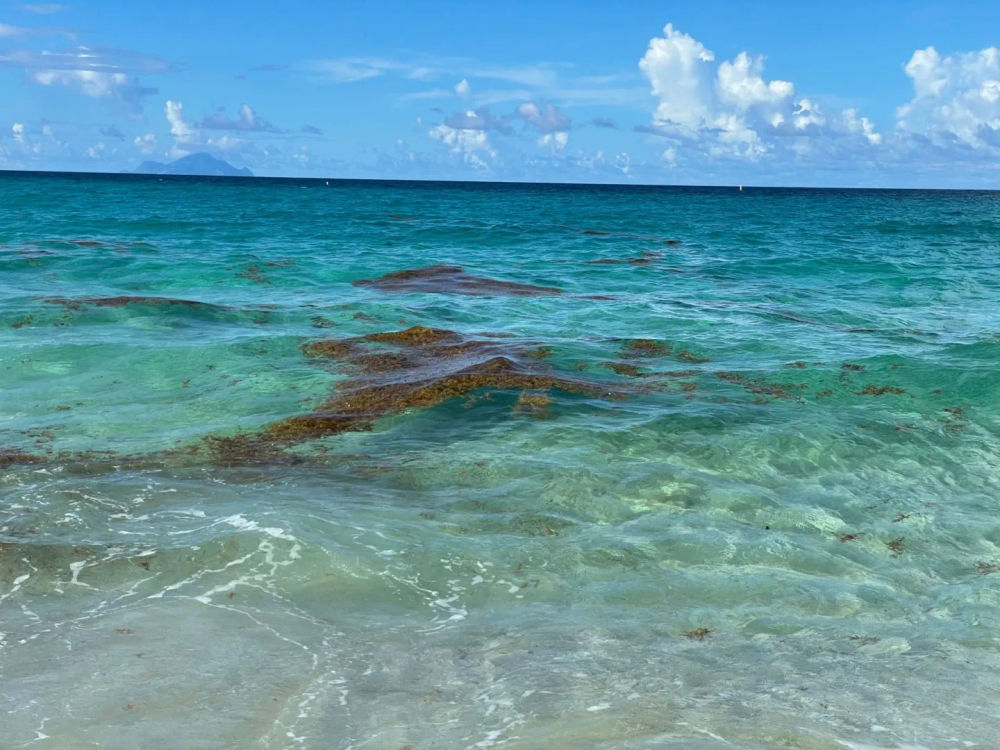
By the time summer is approaching, those floating mats have been drifting for months and hundreds upon hundreds of miles. Many have broken apart and dispersed into smaller clumps, while others have merged into huge rafts. Winds and waves play a final, decisive role: local onshore breezes and the chop of summer storms start driving the algae toward land. For a beach like Tulum’s, facing due east, wide open to the Caribbean, the effect is unavoidable. The seaweed begins to land on the sand in earnest, pushed by wind and surf. At first, it might be subtle: thin lines of brown strands at the high tide mark, a hint of what’s offshore. But often, seemingly overnight, it turns into an onslaught. Whole sheets of sargassum will roll in with the tide, inundating the beaches. Waders in the water find themselves entangled in stringy brown foliage. The turquoise shallows turn a murky amber where the algal rafts hover. By the height of summer, Tulum can look like it’s nestled on the shore of some alien sea, a golden-brown tide lapping at the coast instead of the postcard aqua-blue.
It’s worth noting that not every part of the Caribbean coast gets hit equally. Ocean currents are a bit like weather, there are eddies, curls, and protected nooks. Some lucky coves or leeward sides of islands can remain largely clear, even as a massive raft bypasses them just a few miles away. But Tulum’s location on the Riviera Maya, with open exposure to the east and south, means it often catches a large share of whatever sargassum is drifting by. In a sense, the town is positioned at a crossroads of currents. When the Great Atlantic Sargassum Belt sends its offerings into the Caribbean, much of it eventually finds its way to this corner of the Yucatán coast, funneled by the grand circulation of the sea.

Seasons of the Seaweed
For those who live in Tulum or along Mexico’s Caribbean shore, sargassum has its own seasonal rhythm, a new, unwelcome season added to the calendar. Typically, the first hints of it begin to show up in late winter or early spring. In some years, by February or March, you might notice a few more dried seaweed strands than usual on the beach, a faint whiff of that characteristic odor on the breeze. By April, especially in heavy bloom years, the signs become undeniable: patches of brown weed floating just offshore, or small landings gathering in the corners of beaches.
As spring turns to summer, the sargassum season hits full swing. May and June often bring the heaviest influx. The ocean grows warmer, and the transatlantic bloom that’s been building for months reaches its peak size and momentum. This is when local hotels and authorities brace themselves. You’ll see cleanup crews with rakes and tractors starting their days at dawn, trying to clear the beach before the heat of midday turns the piles into stinking mounds of compost. Yet, during peak weeks, it can feel like shoveling sand against the tide, each new morning, fresh heaps of seaweed await on the shore, as if mocking the cleanup efforts of the day before. The water right at the shoreline can become a thick soup of sargassum fragments, making swimming a less-than-enticing prospect. Still, just beyond the brownish fringe, that alluring Caribbean turquoise beckons where the water remains clear. The contrast can be maddeningly close.
The height of summer, July and August, usually sees the sargassum still coming in strong. It’s the hottest time of year, the tradewinds blowing consistently, and often the bloom in the Atlantic is breaking apart and dispersing, meaning a lot of it is by now in the Caribbean Sea, looking for a place to go ashore. By this point, many locals have adapted to the reality: beachside bars put up windbreaks or barriers, some hotels provide foot baths and even gas masks for staff who have to endure the smell all day, tourists learn to check daily sargassum reports or venture to unaffected cenotes and lagoons for a clearer swim. Conversations in town revolve around seaweed updates: “Playa Paraíso was pretty clear today, but Akumal is a mess,” or “They say a new patch might hit by the weekend if the wind shifts.” It becomes as much a part of daily life as checking the weather forecast.

Then, as September rolls into October, nature’s pendulum begins to swing back. The Atlantic starts cooling ever so slightly from its summer fever. Hurricane season peaks and then tapers off (though ironically, a glancing blow from a tropical storm can either exacerbate the problem by pushing more sargassum ashore in one big rush, or alleviate it by stirring and dispersing the mats, fate’s dice roll). Generally, by mid-autumn, the onslaught slows. The incoming clumps thin out; the water clears more often than not. Autumn sunsets find mostly clean shorelines again, with only the occasional remnant patches of dying seaweed reminding everyone of the summer’s siege. By winter, the beaches of Tulum usually return to their postcard perfection. Locals and tourists alike breathe a sigh of relief in the cooler, clear months of November through February, savoring the reprieve. It’s during these times that one can nearly forget the golden tide ever existed, until the cycle begins anew with the next year’s spring.
It’s important to note that while there is a typical season, sargassum isn’t a perfectly predictable visitor. Some years, an early bloom might surprise everyone and arrive in force by February. Other years, a lean season gives hope that maybe, just maybe, the worst is over, only for the following year to bring record-breaking heaps. The only constant is change: since 2011, no year has passed without at least some sargassum washing up on Caribbean beaches. The amounts fluctuate wildly, though. 2015 was huge. 2018 was even worse. 2022 set new records, and reports suggest 2023 and 2025 were among the heaviest yet, breaking all previous records for sargassum in the Atlantic. The trend isn’t encouraging, but each season’s exact impact on any one beach still depends on vagaries of winds and currents that we can’t perfectly forecast. Two towns just a few kilometers apart might have completely different experiences, one buried in seaweed, the other largely spared, simply because of a quirk in how the currents split that week. This patchiness means living with sargassum is an exercise in uncertainty. You prepare for the worst, hope for the best, and watch the horizon for that telltale line of brown.

The Human Element and a Shared Future
As gritty and messy as the sargassum invasion is, it’s also a vivid symbol of how interconnected our world has become. The fact that choices made by farmers in the Amazon, or factory emissions in North America, or land use decisions in West Africa can indirectly lead to seaweed piling up on a beach in Tulum is a lesson in global ecology. We truly share one ocean, and it responds to all of our inputs. In a very real sense, the sargassum washing ashore is carrying a message. In its soggy, chemical makeup, it carries traces of deforestation in Brazil, tailpipe exhaust from Europe, dust storms in the Sahara, and burning fossil fuels across the planet. It’s a drifting barometer of planetary change.
Yet, amid the challenge, there’s resilience and innovation. The people of Tulum and the broader Riviera Maya have not stood idle. Cleanup crews now are a common sight, combing the beaches at first light like frontline soldiers after a nightly invasion. The work is tough, physical, and never quite done. Municipalities and hotel owners have invested in floating barriers offshore, long nets meant to catch the sargassum before it reaches the beaches and guide it away or concentrate it for collection. Special boats, dubbed “sargaceros,” patrol the waters to scoop up mats in the sea, attempting mitigation at the source. There’s even experimentation with turning the problem on its head: entrepreneurs baking sargassum into bricks for construction, gardeners composting it for fertilizer (with caution, given its high salt and heavy metal content), scientists pondering if it can be harvested and sunk to help sequester carbon. This seaweed, so troublesome on the sand, might yet find a purpose beyond being trucked to landfills.

Emotionally, too, the community has had to adapt. Talk to an old-timer in Tulum, and they’ll recall when summers were only about sun and surf, not seaweed. Talk to a young local, and sargassum is simply a fact of life now, a salty, smelly herald of the summer they’ve grown up with. There’s frustration, certainly: tourism is the lifeblood here, and when the beaches are buried in sargassum, some visitors grumble or leave, businesses suffer, and the postcard image of paradise loses a bit of its luster. But there’s also a gritty determination in the response. Many residents take pride in keeping their beaches beautiful against the odds, organizing community clean-ups, sharing tips on social media about which spots are clear, and learning to read the winds like their ancestors read the rains. In a way, the sargassum has woven itself into the narrative of Tulum, another chapter in the town’s story of balancing growth, nature, and sustainability.
Standing on the shore, it’s hard not to feel a bit poetic about the whole thing. One can watch a clump of sargassum bob in the waves and imagine the journey it’s been on: perhaps it was born near the Cape Verde islands off Africa months ago, nourished by upwelling currents and dust from the Sahara. It drifted west, perhaps mingling with a plume of Amazon water, growing larger. It survived storms, maybe sheltered some fish along the way. And now here it is, at the end of its odyssey, decomposing on the sands of Tulum, completing a cycle that connects continents. In that heap of seaweed lies a tale of two worlds colliding: the wild natural world, doing what it has always done but on a grander scale, and the human world, inadvertently amplifying nature’s hand and then grappling with the consequences washing up at our feet.
As the sun sets over Tulum’s jungle and the last light gilds the drying sargassum with an eerie golden glow, it’s clear this phenomenon is more than a curiosity. It is a reminder, however slimy and smelly, that our planet’s systems are intimately linked. The sargassum will likely continue to come and go in seasons, sometimes lighter, sometimes heavier, as years pass. We will learn more, perhaps manage it better, perhaps reduce our contributions to its excess. But it will remain a part of the Caribbean story, an emblem of a changing ocean. And as with any challenge of this magnitude, facing it will require equal parts science, resilience, and respect for the natural processes at play.
In Tulum, the locals have a saying whenever the sargassum season feels too overwhelming: “Esto también pasará”, this too shall pass. The seaweed came, and surely, in time, the seaweed will go. The beaches will shine turquoise again. Until then, the community will meet the golden tide with perseverance and hope, armed with rakes, boats, and a curious mixture of frustration and awe at the capricious ocean that both giveth and taketh away. It’s a messy, fascinating saga, one still unfolding with each new wave.
We’d love to hear your thoughts, join the conversation on The Tulum Times’ social media.