
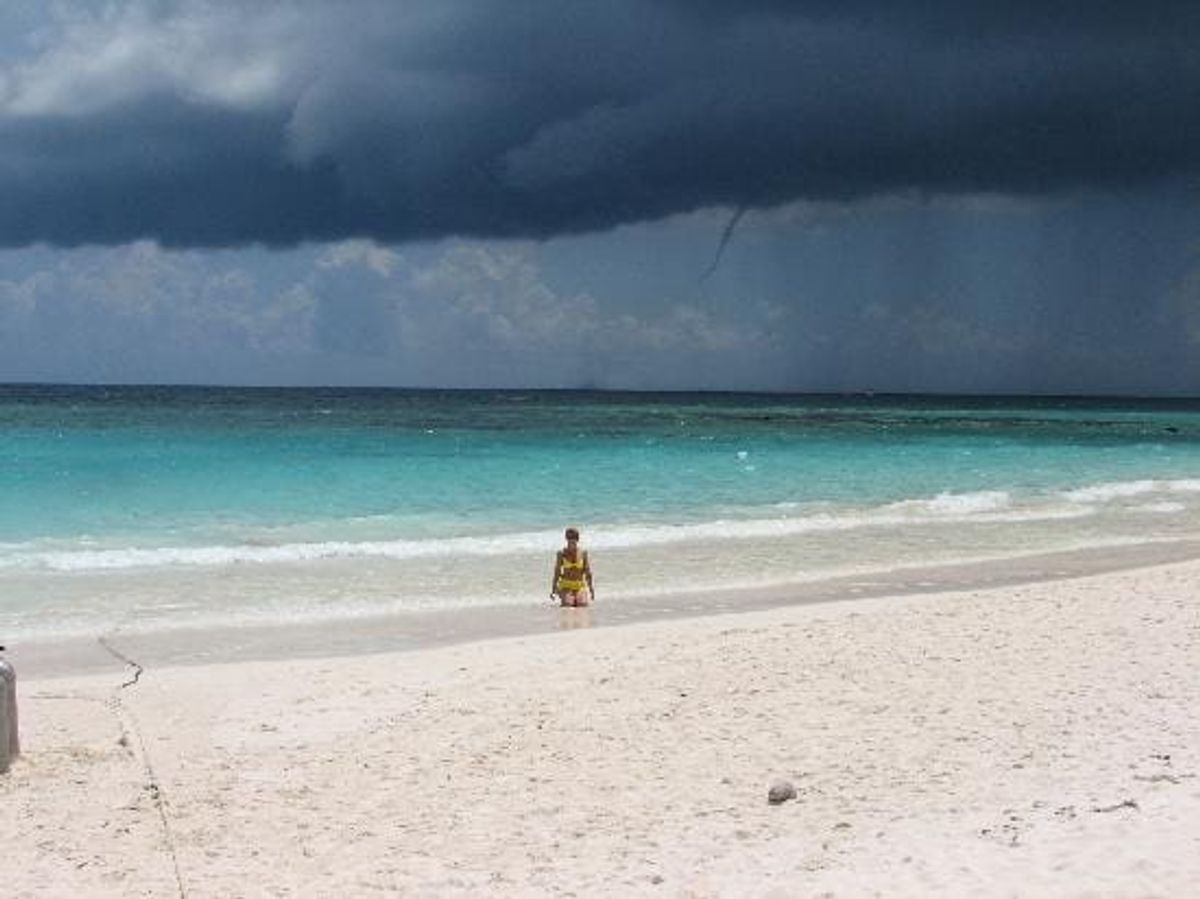
The storm doesn’t knock. It arrives draped in humidity, cloaked in silence, then rips open the afternoon with winds that howl like a pack of wolves breaking through the jungle. Locals in Tulum know the rhythm by heart. First, the heat builds. Then the clouds lower. And then, if nature’s roulette lands wrong, the tropical cyclone begins to circle.
This is not abstract meteorology. In Tulum, the term “tropical cyclone” conjures not diagrams or satellite loops, but memory, of boarded-up windows, sandbags in doorways, and entire neighborhoods gone dark for days. In the vernacular of this coastal Mexican town, the cyclone is not a visitor. It’s a recurring ghost.
Defining the Beast: What a Tropical Cyclone Really Is
A tropical cyclone is, in essence, a rotating engine of heat. Born in the warm belly of tropical oceans, it feeds on water temperatures above 26 degrees Celsius. The heat rises, pressure drops, and winds spiral inward with terrifying organization. At 63 kilometers per hour, it earns the name “tropical storm.” Beyond 119, it’s a hurricane. But labels can deceive. Even weaker systems, when slow-moving, can drown a town.
Unlike tornadoes, which strike and vanish, a cyclone lingers. It can span hundreds of kilometers, pulling ocean tides, air masses, and even human plans into its orbit. And once it touches land, it doesn’t just blow, it drowns, rips, isolates.
The Numbers Don’t Lie: Cyclones in the Yucatán
The Yucatán Peninsula has never been a stranger to storms. Between 1920 and 2020, more than a hundred tropical systems have bruised its shores, including nearly twenty classified as major hurricanes. In the past few years alone, names like Gamma, Delta, and Grace have tattooed themselves onto local memory. One year, it’s broken palm trees. Another, it’s flooded streets so deep they resemble canals. On the worst occasions, it’s lives lost and homes unrecognizable.
In 2024, Tropical Storm Beryl swept past Tulum with winds topping a hundred kilometers per hour. It tore through electrical lines and reminded everyone that even the lower-tier storms can bite. It was not the first. It won’t be the last.
The Anatomy of Impact: How Tulum Takes the Hit
Tulum is flat, geographically speaking, dangerously so. Without elevation to drain rainfall or block the wind, the town absorbs a storm like a sponge. Streets vanish beneath muddy water. Power lines crumple. Cell towers flicker out. Tourists shelter in hallways; locals huddle in candlelight. And in the quiet that follows, there’s the reckoning.
The modern infrastructure has improved, but unevenly. Boutique hotels often recover quickly. But in the outlying barrios, where cement is patchy and drainage non-existent, the damage lasts longer than the headlines. Storms do not discriminate, but their aftermath reveals inequalities in steel and concrete.
Living in the Eye: Preparation as Ritual
June through November is the season of uncertainty. In these six months, every cloud is suspect. Peak danger looms from August to October, when the waters of the Caribbean turn bath-warm and meteorological dice begin to roll.
Preparation becomes habit. Families stockpile bottled water and canned tuna. Radios are tested. Important papers find their way into plastic sleeves. The town’s emergency siren system, once a formality, has gained sharp relevance. Red flags on the beach mean one thing: don’t test the sea. And when the government switches alert levels, from green to yellow to orange, it’s no longer just bureaucracy. It’s time to act.
Evacuation plans exist. But with Tulum’s rapid growth, the roads are often congested even on sunny days. Add panic, and they become gridlock, which is why many choose to stay, to fortify and ride it out. For some, it’s a show of grit. For others, it’s a necessity.
After the Storm: What Recovery Looks Like
The first thing you hear isn’t birdsong, it’s chainsaws. Clearing roads, trimming broken trees, and salvaging. In the hurricane’s wake, the town becomes a mosaic of resilience. Neighbors share generators. Small restaurants hand out free tamales. Children sweep the street alongside their parents. Life, somehow, insists.
But recovery isn’t just physical. The psychological toll is real. There’s the weight of the unknown, when will the next one hit? How bad will it be? Will the roof hold? And what of those who arrived as tourists and leave as evacuees, forever changed by a few violent hours?
Who You Call When the Sky Breaks
In the event of a catastrophe, the first call is often to 911. For emergencies in Quintana Roo, civil protection authorities maintain a direct line, and local shelters activate with each formal storm alert. The fire department, though modest in size, becomes a command center. And a less formal but equally important network, the WhatsApp groups, the neighborhood Facebook pages, carries word faster than official channels ever could.
Still, in moments of chaos, it is often your neighbor who knocks on your door. Who offers candles, or a spare charger, or just company. Because when the lights go out, connection becomes currency.
A Storm That Won’t Go Away
Tropical cyclones are not aberrations. They are patterns. And with each passing year, the data bends in one direction: warmer seas, stronger storms. Climate change doesn’t just amplify the threat, it moves the goalposts. What was once considered rare is now expected. What was once survivable may soon be catastrophic.
Tulum, for all its charm and allure, is a town suspended between beauty and fragility. The same proximity to the sea that draws so many also puts it directly in harm’s way. And the question that floats on every wind now is not if another cyclone will come, but how ready the town will be when it does.
We’d love to hear your thoughts, join the conversation on The Tulum Times’ social media.