
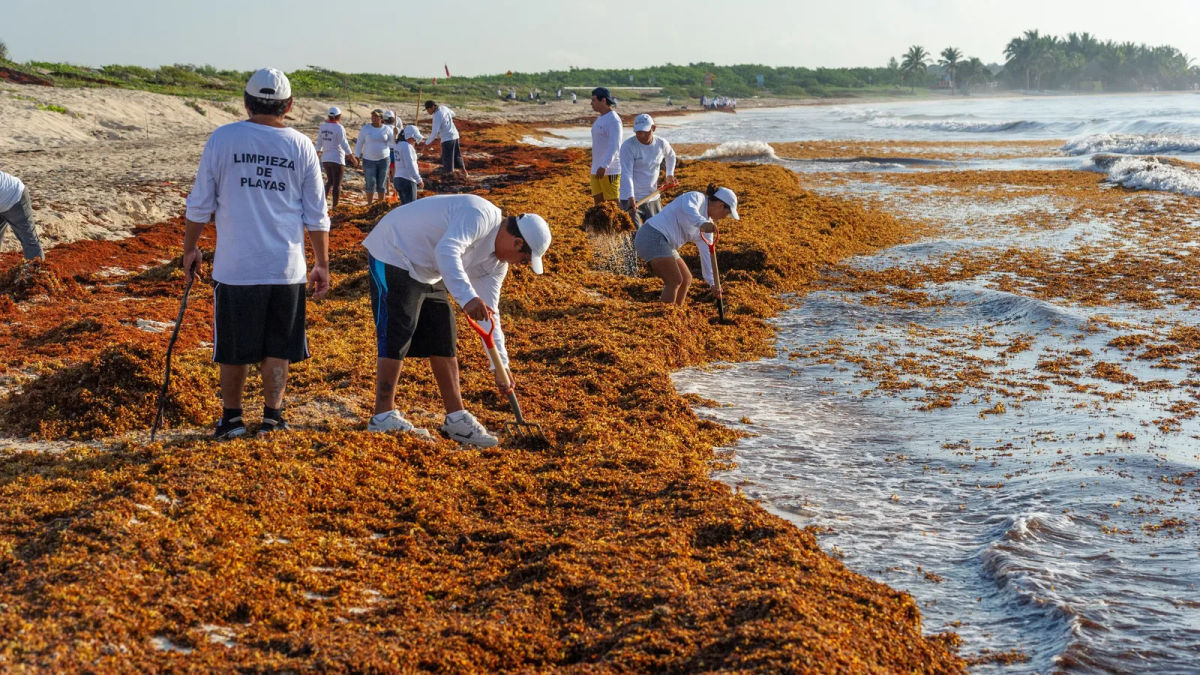
Municipal authorities in Tulum began their annual battle against sargassum earlier than usual this year, collecting more than 185 metric tons of the algae as beaches across the municipality experience an atypically early arrival.
According to local officials, the influx has already affected multiple coastal areas of Tulum, prompting the municipal government to activate cleanup and containment measures months ahead of the typical peak season. Authorities say forecasts suggest that sargassum conditions in 2026 could mirror those seen last year, raising concerns for tourism operators, coastal workers, and residents who rely on clean beaches.
The early response underscores the growing challenges sargassum poses for Tulum, where tourism, public access to beaches, and environmental health are closely tied to shoreline conditions.
Early arrivals trigger municipal response
In response to the unusual timing of the sargassum arrival, the government of Tulum launched coordinated collection efforts at the start of the year. Officials report that more than 185 tons of algae have already been removed from the sand, a figure that reflects both the scale of the arrival and the intensity of cleanup operations underway.
David Buchanan García, director general of Zona Marítima Federal in Tulum, said the volume collected so far confirms early projections of a heavy season. He noted that the early appearance of sargassum along the coast has forced authorities to accelerate preparations that would normally take place later in the year.
According to Buchanan García, collection efforts have focused on preventing the algae from accumulating on the shoreline, where it can emit strong odors, interfere with beach access, and complicate removal once it begins to decompose.
Forecasts point to an intense 2026 season
Municipal and state officials say forecasts indicate that sargassum levels in 2026 could be comparable to those recorded in 2025, a year marked by significant accumulations along the Quintana Roo coastline.
Cristina Torres Gómez, Quintana Roo’s secretary of state, attributed the early arrival to current climatic conditions, including rising sea temperatures and changes in ocean currents. These factors, she said, have altered the timing and movement of sargassum, pushing it toward the coast earlier than expected.
Torres Gómez cautioned that while forecasts do not necessarily predict a worse season than last year, the similarity in projected volumes means authorities and coastal businesses should prepare for sustained cleanup demands throughout the year.
Containers deployed to hotels and public beaches
As part of its response, Zofemat has begun distributing large metal containers to hotels along the Tulum coastline. These containers are being used to deposit sargassum collected from beachfront areas managed by private properties, allowing for faster removal and reducing the risk of algae piling up on the sand.
Buchanan García said the distribution of containers began last week and is intended to improve coordination between hotel staff and municipal cleanup crews. By centralizing where collected algae is deposited, authorities aim to streamline transportation and disposal while keeping beaches accessible.
In addition to hotels, similar containers are being placed in public beach areas. These units are meant to support municipal beach cleaning personnel, who are responsible for maintaining access to beaches used daily by residents and visitors.
Coordination seen as critical to beach access
Officials emphasized that effective coordination between municipal workers, Zofemat, and private beachfront operators will be essential to keeping beaches free of sargassum as new arrivals continue.
Buchanan García said the success of the strategy depends on timely collection and removal once algae reaches shore. Delays, he noted, can allow sargassum to decompose, making it more difficult to handle and increasing environmental and public health concerns.
For Tulum, where beaches are not only an economic engine but also a shared public space, maintaining consistent cleanup operations has become a year-round responsibility rather than a seasonal one.
Impact on residents, workers, and tourism
The early arrival of sargassum affects more than just the visual appearance of Tulum’s beaches. For residents who use public beaches daily, heavy accumulations can limit access and reduce recreational use. Beach cleaning crews face longer shifts and increased workloads, particularly when algae arrives in large volumes.
Hotel workers and tourism businesses are also directly affected. Beachfront properties often deploy their own teams to collect sargassum before guests arrive, and the cost of additional labor and equipment can rise quickly during intense seasons.
For visitors, the presence of sargassum can shape travel decisions and overall experience, making early and visible cleanup efforts a priority for the municipality.
Why this matters locally
Sargassum has become one of the most persistent environmental challenges facing Tulum. Its early arrival in 2026 highlights how shifting climate conditions are reshaping long-standing seasonal patterns, forcing local authorities to adapt faster and invest more resources.
The issue matters in Tulum because clean beaches underpin the local economy, support thousands of jobs, and serve as a shared resource for the community. When sargassum arrives earlier and in large volumes, it compresses response timelines and strains municipal services.
The Tulum Times has previously reported on how repeated heavy sargassum seasons have pushed municipalities across the Riviera Maya to rethink cleanup strategies and long-term coastal management.
What happens next as arrivals continue
Authorities say cleanup operations will continue as long as sargassum keeps reaching the coast. With forecasts pointing to a season similar to 2025, Zofemat and municipal crews are expected to maintain container distribution and collection schedules throughout the year.
While officials have not announced new measures beyond current collection and coordination efforts, they stress that monitoring conditions will remain ongoing. Any significant change in volume or arrival patterns could prompt adjustments in staffing or equipment deployment.
For now, the early start to the 2026 season has set the tone for months of sustained effort, with the stakes centered on beach access, environmental conditions, and the economic stability of Tulum’s coastal zone.
As sargassum continues to arrive, the effectiveness of coordination between authorities, hotels, and cleanup crews will shape how the season unfolds and how the municipality manages one of its most visible environmental challenges.
The primary concern remains clear: keeping Tulum’s coastline usable as sargassum reaches shore earlier and in volumes comparable to last year. We’d love to hear your thoughts. Join the conversation on The Tulum Times’ social media. How do you think Tulum should adapt as early sargassum arrivals become more common?