

Along the sun-washed shores of Tulum, sargassum has made its return in force, and this year, it’s not pulling any punches.
After a six-month silence, two Navy vessels are back in the water, slicing through the waves off Tulum’s coast. Their mission? Stop the brown tide before it slaps the sand. These aren’t just boats, they’re frontline fighters in a long, exhausting war against a natural invader that’s both an ecological marvel and a tourism nightmare.
The floating dock, now under construction, will soon allow faster offloading and safer maneuvering, a practical improvement with high stakes. As David Buchanan García, head of Tulum’s Federal Maritime Terrestrial Zone (Zofemat), explained, the resumed operations just weeks ago could be the difference between clean beaches and mass tourist withdrawals.
A Maritime Menace
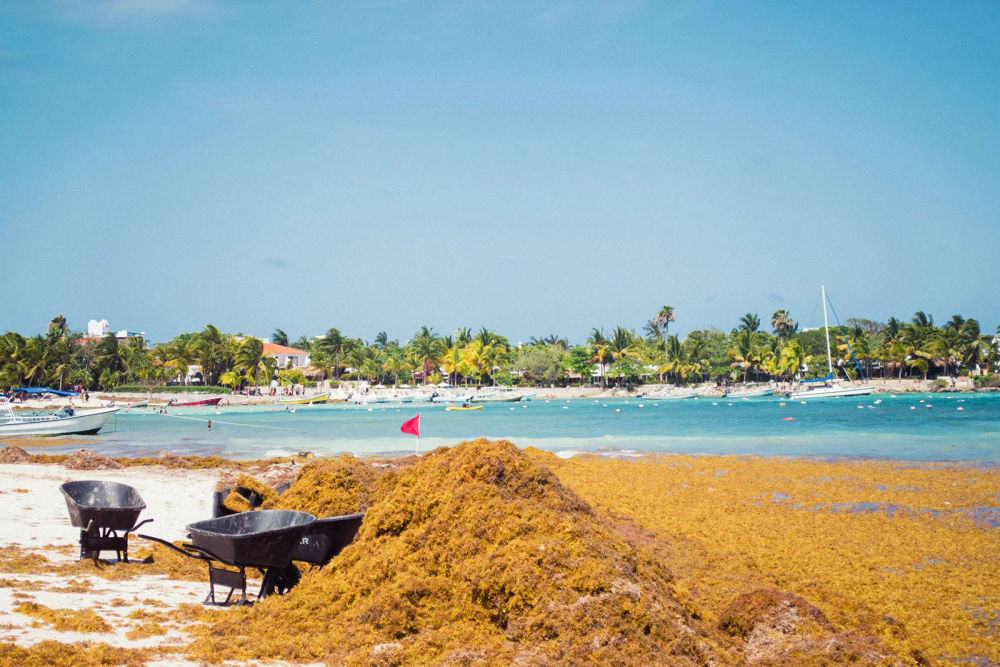
Sargassum is no stranger to the Caribbean. It drifts from the Atlantic, golden and harmless-looking, until it lands. That’s when the rot sets in, literally. What was once a floating habitat becomes a stinking carpet. It releases hydrogen sulfide and ammonia as it decays, irritating eyes, choking lungs, and sending both locals and tourists scrambling indoors.
This year, it’s worse. According to researchers at the National Autonomous University of Mexico (UNAM), sargassum levels are projected to rise by 40% compared to previous years. Leticia Durand Smith, a researcher at UNAM’s Regional Center for Multidisciplinary Research, warned it could surpass even the worst seasons, 2018 and 2023, when the seaweed didn’t just blanket beaches, it smothered coral reefs and battered local economies.
A Region Under Siege
In Cancún, more than 14,000 tons have already been cleared, nearly four times the amount removed in 2024. “We surpassed last year’s figures since June,” said Antonio Chambé, director of public services in Benito Juárez municipality. “Today’s figure is historic. We’ve had large amounts of sargassum arriving, especially along the coast from Delfines toward Chac Mool.”
The scope is daunting. From Playa del Carmen to Mahahual, beachfront businesses are scrambling for solutions. Tourism operators know the math: brown beaches mean canceled reservations, empty tour boats, silent bars. In a region where sun and sea sell paradise, sargassum is bad for business, and worse for the soul.

A Micro-War on the Water
At dawn, a local crew leader in Tulum, José, watches the horizon as one of the Navy vessels churns past. “Before the dock, they had to do it all the hard way,” he says, wiping sweat from his brow. “Now, maybe they can move faster.”
The planned floating dock, promoted by the National Commission of Natural Protected Areas (Conanp), aims to boost operational efficiency while reducing the danger to personnel. Each load of seaweed collected offshore is one less dumped on the sand, one less truckload for municipal crews to shovel away under the tropical sun.
José has worked on sargassum patrols for four seasons. “It used to be a beach job,” he says, “Now it’s a sea job.”
Regional Reflection
Tulum isn’t alone. The entire Riviera Maya has become a testing ground for sargassum response strategies. Cancún relies on intensive beach clearing and floating barriers. Playa del Carmen experiments with offshore containment. And Tulum? It’s betting on open-sea interception, a method with promise, but no guarantees.
Compared to larger municipalities with deeper pockets, Tulum’s strategy might seem ambitious. But it’s also deeply local. The goal isn’t just cleaner beaches, it’s preserving a way of life.
The Tulum Times has followed this issue closely, documenting how environmental challenges intersect with tourism, public health, and the fragility of Mexico’s coastal ecosystems. The question isn’t whether sargassum will return. It’s how well communities adapt when it does.
Unpredictable Tides, Uncertain Futures
Sargassum’s seasonal assault typically fades by November, with the arrival of cooler fronts. Until then, the “Todos Contra el Sargazo” (Everyone Against Sargassum) program will remain in full swing. And the Navy’s presence at sea signals a renewed sense of urgency, if not hope.
Still, experts warn that climate change, rising sea temperatures, and oceanic nutrient shifts may be feeding these massive blooms. What was once considered a seasonal nuisance now feels like a recurring crisis. And while the science catches up, communities like Tulum must improvise in real time.
This battle plays out quietly at sea, but its impact ripples across hotel rooms, beach weddings, seafood kitchens, and taxi rides. It’s not just about the seaweed. It’s about survival.

The Fight Beneath the Waves
A biologist once described sargassum as a “moving forest.” It shelters fish, turtles, and seabirds on its journey across the Atlantic. But like a forest fire, when it rages uncontrolled, it consumes everything in its path.
The renewed Navy effort is just one tactic in a long war. And in a year already marked by record invasions, there’s little room for error.
Because in the end, sargassum doesn’t just wash up on the shore. It arrives in the economy, in the lungs of workers, in the eyes of disappointed tourists. And it stays there, unless someone stops it.
We’d love to hear your thoughts. Join the conversation on The Tulum Times’ social media.
Will these renewed efforts be enough, or is the seaweed tide turning for good?