
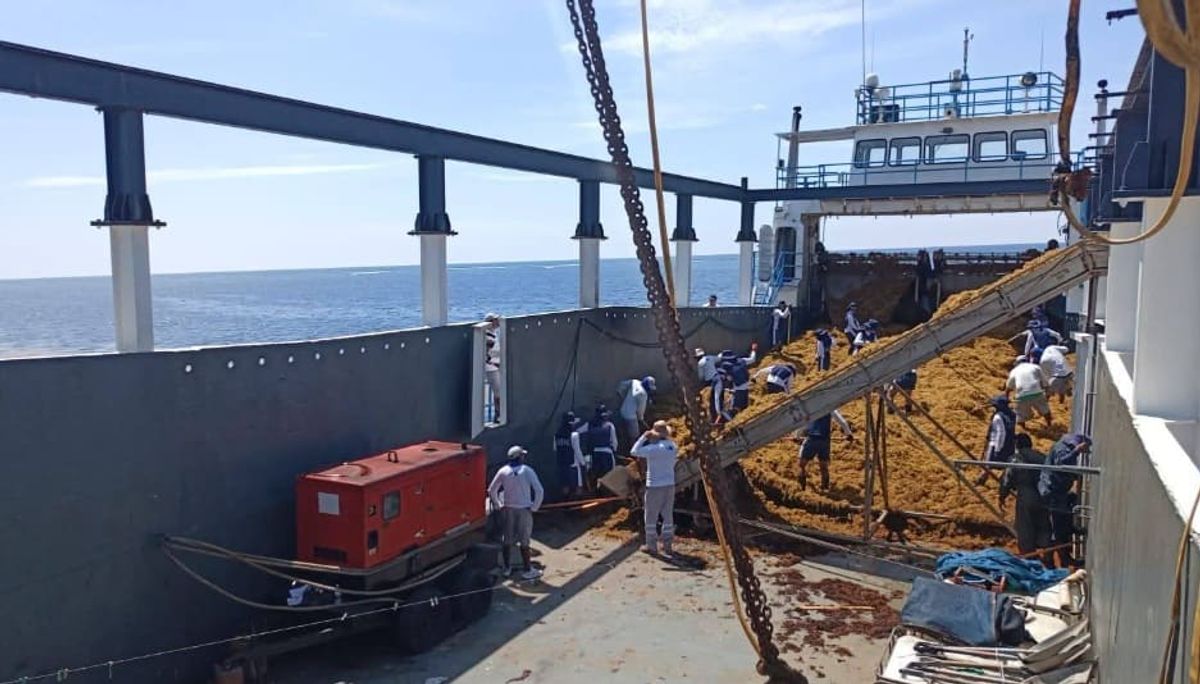
Just offshore from Tulum’s white-sand beaches, two Navy vessels hum back to life after six long, silent months. Their mission? To intercept the relentless brown tide of sargassum before it smothers the coast, again.
The return of these collection ships isn’t just a technical update. It’s a frontline defense in one of Tulum’s most persistent environmental battles. And this time, local authorities say they’re ready to fight smarter.
Sargassum Season Hits, and Tulum Responds
Two of the three Navy vessels assigned to Tulum are now back in operation, gliding through the seaweed-heavy waters off the municipal coastline. Admiral Marco Antonio Muñoz Hernández, Commander of the XI Naval Zone, confirmed the trio underwent maintenance at the fiscal pier in Chetumal. Now, with their engines tuned and hulls reinforced, they’re returning to waters that haven’t seen coordinated naval sargassum collection in more than half a year.
The question is, will it be enough?
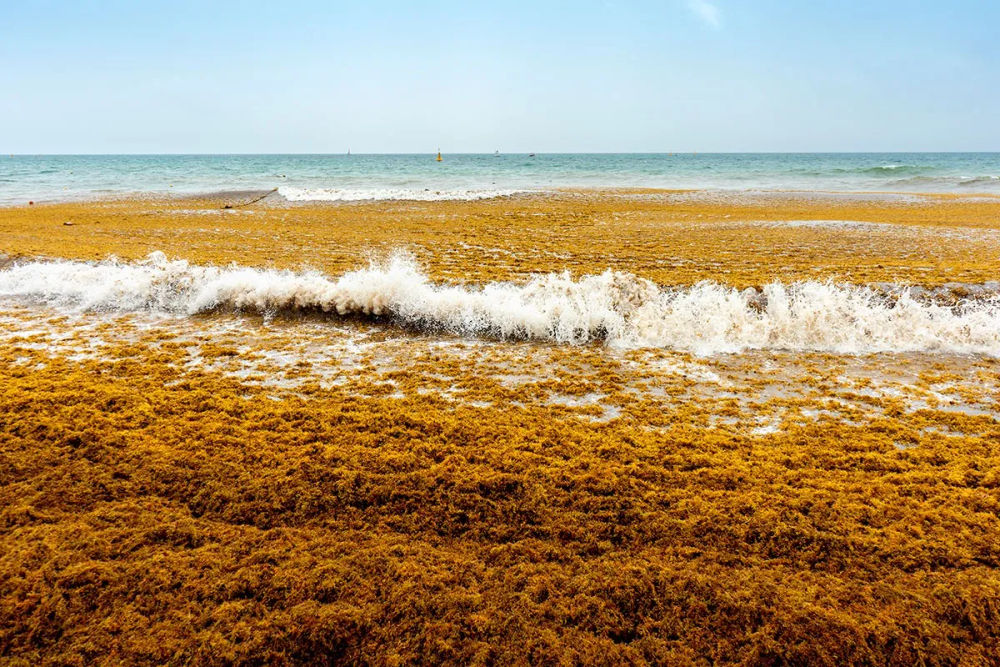
Sargassum, a once-ignored seaweed, has become a repeating nightmare for Riviera Maya beaches. It blankets the shores, fouls the air with a sulfuric reek, and erodes both tourism revenue and local morale. In a place where the ocean is sacred, that’s not just bad optics, it’s a crisis.
“We’re not just talking about trash on the beach,” said David Buchanan García, Director of the Federal Maritime Terrestrial Zone (Zofemat) in Tulum. “This is about protecting the ecosystem, the economy, and the image of Tulum as a world-class destination.”

Floating Solutions for a Floating Problem
This time, the strategy isn’t just about reaction, it’s about logistics. A new floating dock is being installed off the coast, designed to ease the unloading of sargassum from the vessels. The project, promoted by the National Commission of Protected Natural Areas (CONANP), could be a game-changer for daily naval operations. It’s not just a technical fix. It’s a signal: this is no longer an ad-hoc cleanup. It’s a permanent front line.
The dock will allow for faster, safer transfer of collected sargassum, cutting down on delays that once let tons of seaweed rot in the sun before disposal. “With these logistical improvements, we expect a much more efficient collection system,” Buchanan García noted.
There’s a subtle shift in tone here. Less panic. More planning.

The Human Toll of a Murky Crisis
Walk the beaches of Tulum at sunrise, and you might spot workers already hauling mounds of seaweed before tourists arrive. Some are government contractors. Others are locals desperate for extra pesos. All are battling the same algae.
One such worker, Julio from nearby Chemuyil, spends six days a week raking and shoveling. “It used to be a job. Now it feels like a war,” he says, sweat streaking his shirt even before the heat of midday.
The physical toll is real. But the emotional fatigue might be worse. Business owners watch guest bookings rise and fall like the tide, depending not on reviews or prices, but on the color of the water.
When the ocean turns brown, cancellations surge.
Why Tulum Can’t Afford to Lose This Fight
Unlike Cancún, where hotel chains have the muscle and money to deploy private barriers and cleaning teams, Tulum’s charm lies in its raw edges. That makes it more vulnerable, and more authentic. But authenticity doesn’t clean beaches.
The environmental cost is harder to calculate. Marine life is tangled in seaweed mats. Coral reefs starved of sunlight. A coastal balance thrown off-kilter by forces far beyond Mexico’s borders. Scientists suspect the cause lies in nutrient runoff from the Amazon, mixed with warming seas. But here in Tulum, the causes matter less than the consequences.
This isn’t just a story about seaweed. It’s about survival.
A Glimmer of Coordination, at Last
For years, critics pointed to the fragmented response: federal, state, and local agencies operating in silos. That’s starting to shift. The collaboration between the Navy, Zofemat, and CONANP shows a more united front. It’s a small sign, but it could mark a turning point.
Still, the scale of the problem looms large. Sargassum isn’t a seasonal glitch anymore. It’s becoming the new normal.
And as that reality sinks in, Tulum must adapt, or risk being swamped, literally and figuratively.
Looking Ahead: A Fragile Hope
Nobody’s declaring victory. Not yet. But for the first time in months, there’s movement offshore and muscle behind the mission. With the Navy’s return and local coordination on the rise, there’s a fragile hope that this year’s battle won’t be lost before it begins.
“This isn’t a one-time fix,” a local hotel owner told The Tulum Times. “It’s trench warfare. Every morning. Every tide.”
But in this gritty fight for the soul of the coast, perhaps that’s what it takes.
We’d love to hear your thoughts. Join the conversation on The Tulum Times’ social media.
Is this the turning point Tulum needs, or just another round in a long, algae-filled fight?