
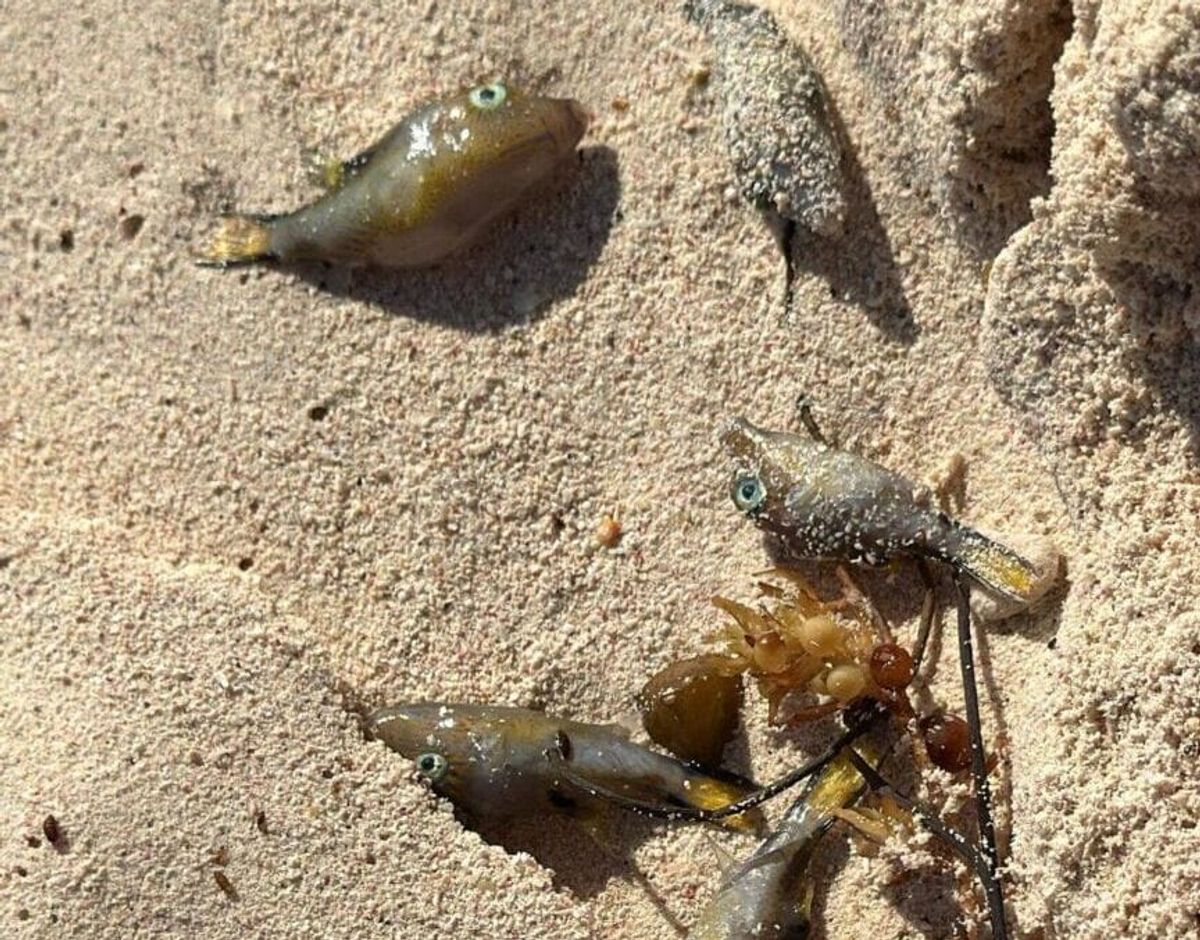
The Tulum pufferfish die-off reported Tuesday morning drew immediate attention from environmental authorities after hundreds of sharp-nose pufferfish washed up along several kilometers of shoreline. The event stretched from Playa del Pueblo through the hotel zone and toward Santa Fe Beach inside the Jaguar National Park. What appeared at first to be an isolated incident quickly evolved into a wider examination of how coastal conditions in Quintana Roo might be shifting as the region moves deeper into the post-cyclone season.
Officials arrived before midday to collect specimens. Locals had already begun sharing videos, asking what might have caused the sudden death of so many small fish. The scene became a reminder of how fragile the Riviera Maya’s marine systems can be, especially during times of temperature change and drifting sargassum.
Scientists focus on species details as early findings emerge
José Juan Domínguez Calderón, director of the Mexican Caribbean Biosphere Reserve in Tulum, confirmed that the fish belonged to the sharp-nose puffer species, known scientifically as Canthigaster rostrata. Some residents call it tamborín narizón. The species is small, tropical, and widely distributed from South Carolina to the Lesser Antilles, typically inhabiting coral reefs and seagrass meadows between one and forty meters deep. It feeds on sponges, crustaceans, mollusks, sea urchins, and algae, and rarely grows beyond 11.5 centimeters.

The scientific profile matters because it helps narrow the possible causes. Pufferfish like these tend to remain close to the seabed, where conditions can shift quickly if currents warm, oxygen levels drop, or drifting vegetation resuspends sediment. Yet environmental officials said they still did not have a confirmed explanation.
Domínguez Calderón emphasized that investigations are underway. “We do not know exactly what it was. Last time something similar happened, it was linked to sargassum. In other parts of the country, a comparable event involved a toxic algal bloom,” he said. Samples are being sent to El Colegio de la Frontera Sur (Ecosur) and Mexico’s federal health agency, Cofepris, for analysis. Results could clarify whether biological, chemical, or meteorological factors played the dominant role this time.
The Tulum pufferfish die-off echoes past seasonal patterns
For many local fishermen, however, the sight was hardly surprising. Alonso Gutiérrez Sánchez, a Tulum boatman, described the event as cyclical. He said that almost every year, pufferfish move upward from the seabed when the water temperature changes, seeking shelter among drifting seaweed. Monday saw a modest influx of sargassum. When the algae washed ashore overnight, the small fish were carried with it.

“These fish usually stay near the bottom, and when the temperature changes, they come up and hide in the algae. We had some sargassum arriving. Then it goes to the shore and brings the fish with it,” he said.
Gutiérrez Sánchez added that the phenomenon often appears near the end of the cyclone season. This time it expanded across the entire shoreline, making it more visible to tourists, residents, and hotel workers. Even so, he said it did not appear to pose an unusual risk.
His observation adds a micro-story that helps frame the issue: experienced workers who spend their days on the water tend to recognize patterns long before official assessments arrive.
Regional scientists point to recurring events across the Caribbean
Marine biologists working with Ecosur have seen comparable die-offs from the Mexican Caribbean to Colombia. One researcher, who asked not to be named, said internal examinations of specimens from various locations, including Belize, showed no lesions or trauma that could explain the mass deaths. That absence of physical damage complicates the study because it suggests something environmental rather than pathological.
“There has been discussion that it could be linked to rising temperatures,” the researcher said. “But we are never in the right place at the right moment to measure.”
Their comment underscores a persistent challenge in coastal science. Many events happen quickly and in locations where systematic monitoring is limited, particularly in nearshore zones where sargassum accumulates. The uncertainty also shows how complex the interactions can be between temperature swings, oxygen levels, and underwater vegetation.

When local knowledge and scientific caution intersect
The contrast between formal investigations and the experience of fishermen reflects a dynamic often seen across Quintana Roo. Local workers interpret marine behavior through decades of observation, while scientists operate within frameworks dependent on lab results and measurable indicators. Both perspectives matter. And both can coexist even when they do not fully align.
It would be premature to assume a single cause. Environmental shifts in the Riviera Maya might be becoming more frequent, and small changes in water quality could have outsized effects on species with narrow habitat preferences. That interpretation is not a prediction but an observation about the complexity of managing a coastline under pressure from climate variability, tourism growth, and the recurring presence of sargassum.
A line heard repeatedly along Tulum’s beaches captured the mood: “Nature is moving faster than our measurements,” a sentiment that traveled quickly on social media.
What authorities might look for next
The coming days will likely focus on the results from Ecosur and Cofepris. Scientists could examine oxygen levels, trace compounds, or phytoplankton composition. Warmer water, especially in late autumn, can reduce dissolved oxygen, stressing smaller species first. Sargassum mats can create low-oxygen environments when they decompose, intensifying the risk.
At the same time, authorities will evaluate whether this die-off aligns with last year’s patterns. If it does, it could support the fishermen’s argument that the event is seasonal rather than exceptional. But if new variables appear, the response might expand to include additional monitoring or shoreline advisories.
Tourism operators in Tulum and neighboring areas like Akumal and Playa del Carmen are also paying attention. While the pufferfish are small and pose no threat when dead, beach visibility affects visitor perception. Hoteliers in Quintana Roo have learned in recent years how quickly global conversations about sargassum or water quality can influence travel decisions.
A coastline adapting to the slow rhythm of change
Even without a definitive explanation, the die-off points to a broader reality: ecosystems along the Mexican Caribbean appear increasingly sensitive to temperature swings and vegetation movement. The region’s shallow reefs, which support not only marine life but also local economies, operate within narrow environmental margins. When those margins shift, even slightly, species like Canthigaster rostrata might be among the first to react.
This is where subtle reflection is needed. Events like this remind residents, tourists, and officials that coastal management is not just about reacting to what washes up on the sand. It requires understanding what is happening offshore, often out of sight. Environmental patterns might be becoming more frequent and more visible, which could push authorities to develop better predictive tools.
One quiet beach scene carried a simple message: the coastline remembers more than it reveals. The Tulum Times has covered numerous environmental stories across the Riviera Maya, and this one adds another layer to the ongoing challenge of reading the signals coming from the sea.
What remains at stake for Tulum’s shores
The Tulum pufferfish die-off might ultimately be categorized as a natural seasonal occurrence. Or it could join a growing list of events tied to broader environmental stressors along Mexico’s Caribbean coast. Either way, shoreline communities and scientists will be watching how the next weeks unfold.
Understanding the cause could help refine local strategies for monitoring sargassum, adjusting fishing practices, and preparing for future temperature shifts. The stakes are small in appearance but large in implication, because each event reveals how interconnected Tulum’s reefs, beaches, and marine species have become.
We’d love to hear your thoughts. Join the conversation on The Tulum Times’ social media.
What patterns have you noticed in Tulum’s coastline over the years?