
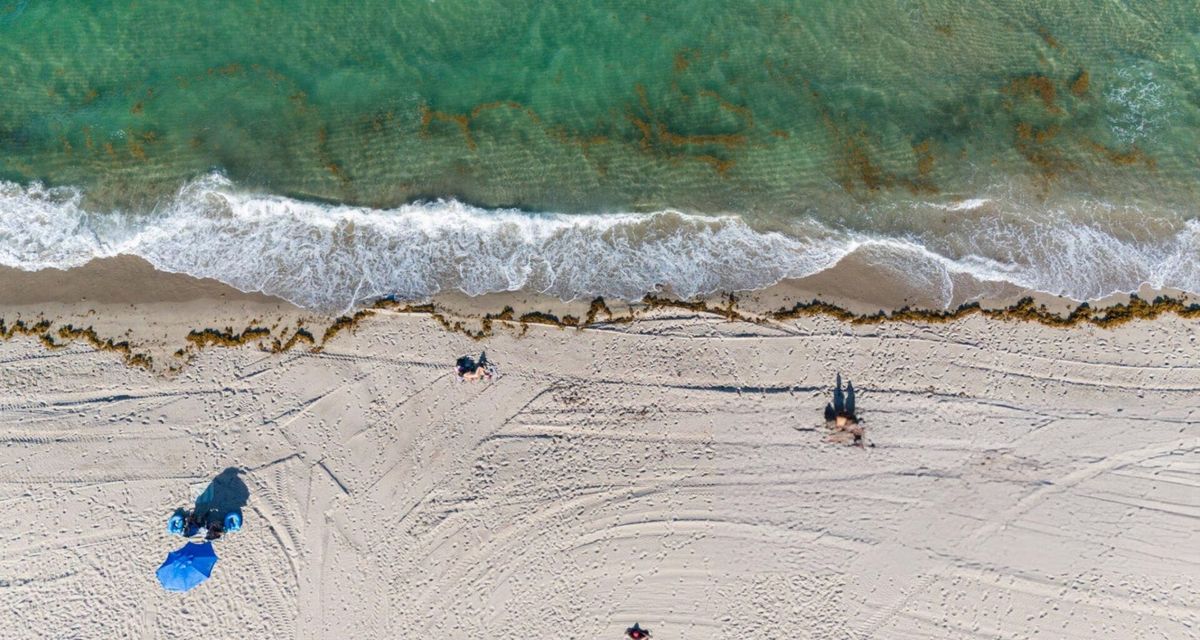
For weeks now, the turquoise waters of Tulum have looked almost like postcards again, clean, clear, and strangely calm. Locals say it feels like the ocean is catching its breath.
But why now? Why the sudden pause in the endless invasion of sargassum that’s plagued the Riviera Maya’s coastlines year after year?
According to Esteban Jesús Amaro Mauricio, director of the Sargassum Monitoring Network in Quintana Roo, this moment of clarity might be nature’s doing. He says shifting ocean currents and a lull in the trade winds have rerouted the algae’s path. And for now, Tulum is mostly out of the line of fire.
What’s Really Going On with the Seaweed?
Sargassum, a brown, buoyant seaweed that smells like rotten eggs and stains the white sand beaches in streaks of rust, has become a seasonal nightmare for much of Mexico’s Caribbean coast. It’s not just a cosmetic issue. For tourism-reliant towns like Tulum, Playa del Carmen, and Puerto Morelos, the presence, or absence, of the seaweed can swing economies.
So when the beaches clear, even temporarily, it doesn’t go unnoticed.
This recent shift in ocean behavior has sent the sargassum masses drifting elsewhere. But “elsewhere” still means somewhere. Amaro Mauricio points out that while Tulum breathes easy for now, other parts of Quintana Roo are catching the brunt: the eastern shores of Cozumel, the northern strip of Puerto Morelos, and the more remote southern spots like Mahahual and Xcalak are still buried under mats of seaweed.
“It’s like the sea moved the problem instead of solving it,” says a local fisherman in Mahahual, who’s been pulling sargassum from his boat propellers every morning. “We’re still dealing with it. Just not where the tourists are.”
Nature’s Curveball or Just a Lucky Break?
For those who track the phenomenon, predicting sargassum is a bit like forecasting mood swings, it’s all guesswork layered on top of uncertainty. What Amaro Mauricio makes clear is that these calmer waters might last through the fall, but that’s a big “might.”
Sargassum, he reminds us, is driven by a cocktail of global forces: ocean temperatures, wind patterns, and even Saharan dust blown across the Atlantic. A small shift can send tons of algae barreling toward the Riviera Maya with no warning. The temporary calm shouldn’t be mistaken for a trend.
And yet, the quiet beaches are undeniable.
A Short Story in the Sand
On a recent morning, a couple from Monterrey walked barefoot along Playa Paraiso, snapping selfies against a sea that looked too perfect to be real. “We postponed our trip three times because of the seaweed,” the woman said. “Now we’re here, and it’s like it waited for us.”
That morning, a hotel worker leaned on his rake and watched the waves roll in. “I’ve had three weeks without lifting sargazo,” he said. “I don’t know what to do with myself.”
His laugh was short, unsure. They’ve seen these pauses before, and they never last.
What This Means for the Region
In the broader Riviera Maya, where tourism infrastructure is often built without fully considering environmental volatility, moments like these are both a blessing and a warning. Yes, it’s good news that Tulum’s beaches are clean. But the shifting of the problem to other zones like Cozumel or Xcalak only highlights the fragility of the system.
And it raises a question: Are we celebrating nature’s grace or ignoring the next wave?
Local businesses, from beachfront bars to scuba shops, have felt the immediate relief. With fewer complaints, better photos, and a bump in beachgoers, many have resumed their full-service operations. But it’s hard to shake the collective anxiety, because the sargassum always returns.
In Cancun, a tour operator who asked not to be named said it plainly: “We’re all just waiting for the other flip-flop to drop.”
Tulum’s Resilience and Responsibility
The Tulum Times has covered the sargassum saga for years, from the peak of 2018’s crisis to the experimental barriers and cleanup programs that followed. This latest shift adds another wrinkle to an already complex story, one where natural forces, tourism pressures, and climate shifts all intersect.
Tulum might get a break today, but what happens when the currents change again tomorrow? And what about the smaller communities further south, who don’t have the media attention or resources to manage the problem when it hits their shores?
As Amaro Mauricio reminds us, vigilance remains essential. Scientists, government agencies, and local communities are still monitoring, tracking, and bracing for the unpredictable.
It’s not just about seaweed anymore. It’s about learning to live with a coastline that answers to no one.
What’s at Stake Now
The sea is fickle, and Tulum’s fortune could change with the next wind. The respite from sargassum gives the town a moment to recover, but not to forget.
Because beneath the clear water, the same ocean that gives Tulum its allure is still shifting. And its next move might not be so kind.
We’d love to hear your thoughts. Join the conversation on The Tulum Times’ social media.
How do you think the region should prepare for the next wave of sargassum?